Market Insight
Great Content, Disappointing ROI
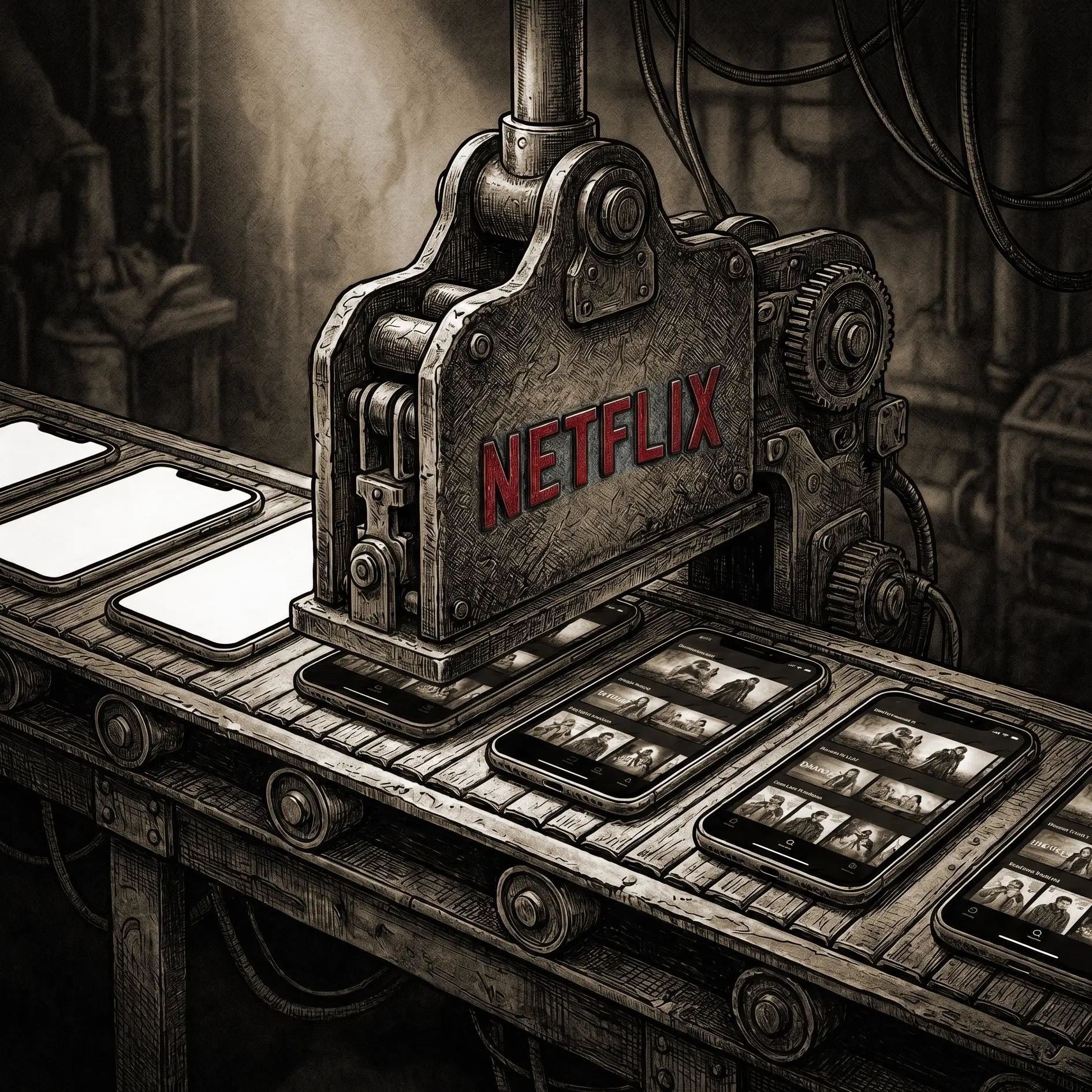
Is the Netflix blueprint hurting OTTs? The copycat experience may be contributing to weaker returns.
Is the Netflix blueprint hurting OTTs? The copycat experience may be contributing to weaker returns.
It is a universally acknowledged modern tragedy: it’s Friday night, your dinner is perfectly hot, and you sit down on the couch ready to unwind. You open your favorite streaming app. You scroll. You scroll some more. You watch three auto-playing trailers, browse five different categories, and check your phone. Twenty minutes later, your food is cold, your brain is exhausted, and you end up putting on a comfort show you’ve already seen a dozen times-or worse, you just turn the TV off.
This phenomenon is not a personal failing; it is a systemic design flaw. For the past decade, the Over-The-Top (OTT) media industry has treated the Netflix User Experience (UX) as the undisputed gold standard. However, the very interface designed to keep us engaged is now driving viewers away. By overwhelming users with endless grids of content, OTT platforms are inducing severe cognitive overload and masking a fundamental truth: very few services have achieved true personalization.
When Netflix transitioned from mailing DVDs to streaming digital video, it had to invent a new way to browse. The solution was the now-ubiquitous "digital video store" model.
This UI is characterized by horizontal carousels (or "swimlanes") stacked vertically, auto-playing background trailers, and algorithmic rows like "Trending Now" or "Top 10." While revolutionary at the time, this interface has calcified into an industry-wide trap. Competitors like Prime Video, Disney+, Max, and Hulu largely copy-pasted this architecture. The problem with this homogenization is twofold:
Instead of feeling like a tailored concierge service, logging into an OTT platform feels like walking into a crowded, noisy bazaar where every vendor is shouting at you simultaneously.
At the heart of the OTT discovery challenge is a psychological principle known as the Paradox of Choice, popularized by psychologist Barry Schwartz. The premise is simple: while a certain amount of choice is liberating, an abundance of choice is paralyzing.
When viewers are presented with 10,000 titles, the brain must process an immense amount of data to make a decision. This triggers decision fatigue. Viewers hesitate to commit to a two-hour movie because they fear a better option is just one more scroll away-a modern digital manifestation of FOMO.
By offering everything, OTTs effectively offer nothing. The burden of curation is entirely offloaded onto the user, leading to frustration, app abandonment, and ultimately, churn.
To combat choice paralysis, OTT platforms tout their "sophisticated recommendation algorithms." We are given rows labeled "Because you watched X," or shown a "98% Match" score. However, this is largely an illusion of personalization, not the reality of it.
Current OTT recommendation engines rely heavily on collaborative filtering (finding similar users) and basic metadata tagging. Why does this fail? Because it lacks deep contextual understanding. Is it a Friday night movie with family? A Tuesday morning commute? Are they looking to learn, laugh, or cry? The current algorithms are deaf to human mood and context.
Because almost every major player has adopted the Netflix layout, the entire industry is suffering from the same friction. For smaller, niche OTT platforms, mimicking this UX is actively detrimental.
If a niche documentary platform uses the same endless-scroll grid as a multi-billion dollar giant, it only highlights their smaller catalog. Instead of feeling like a carefully curated boutique, it feels like a half-empty supermarket. By failing to innovate on the interface level, OTTs are missing a critical opportunity to differentiate their brand and build deeper relationships with their audiences.